
Operators: SCO, logistics, API and qualified balances
In the “Accounts” section of the Advanced Supply Chain Portal (ASCP), the focus is connecting supply chain operators (SCO) to users. Wizards with simple step-by-step and “Update All” functions complete the tasks, much like buying a multi-option product online.

Key takeawaysoperators
- The account control panel has three components: SCO & API settings, project & segment settings, and qualified balance settings.
- Every operator and logistics segment gets its own database, secured and tracked with API keys.
- Operators design their SOP without code; the portal fills in users’ forms from their profiles.
- Users decide what funding information operators may see, globally or per vertical.
Built on experience
RIF had many advantages in designing the supply chain operators’ database and API components. They include the 2000–2001 work behind what Milinx billed as the first fully hosted desktop operating system,[1] and a Universal Database Connect, or buffer protocol, that by RIF’s account was active eight years before Google released or implemented similar technology. The talent was there to make sure it worked.
SOP (standard operating procedures) integration is a subset of the supply chain operators’ (SCO) best practices. A WYSIWYG interface lets the SCO define and design the SOP without programming or coding skills. The step-by-step process would hold all the information the SCO/LOG provider needs, and fill in forms for the user automatically from their profile.
The portal also had one important task: to activate and create the databases for each SCO/LOG (“LOG” for logistics) provider segment, using API keys to secure and track activity and access. Database sync was a separate application, with add-field functions and a shared database architecture in a cloud-type configuration.

The account control panel
Details of users’ projects, and shared connections that are missing an authorization or start setting, are core functions of the account control panel.
Its three main components:
- SCO & API settings
- Activate and create the databases for project creation. They are integral to the open-source architecture of the RIF Industries Advanced Supply Chain Portal (ASCP). The form was designed to automate the creation of these databases and tables, with settings customized to SCO/LOG and SOP step-by-step requirements.
- Project & segment settings
- Create projects and set the add functions for segments. They include automated creation of API keys, databases, default permissions and user profiles for payment and billing, based on the IV (industry vertical) or the SCO/LOG; and automated or manual presentation of options and add-value options based on the user’s settings.
- Qualified balance settings
- Set up funding sources and pricing. Automation or payment of requests is also managed from the user’s settings. This component tells the SCO whether the user has set up funding sources and project funding levels, if the user grants that permission to the SCO/LOG, either globally or in detail by SCO/LOG and industry vertical.
SCO & API settings
- API linked
- Confirms how many supply chain operators’ APIs have been activated.
- Type
- The type of activation: SCO (supply chain operators) or LOG (logistics operators of services).
- API connect
- How many are being activated and connected to SCO products and services.
- SCO LOG linked
- The number of APIs, or links, to SCO or LOG products and services.
- Last log entry
- For security: the last event on that project account.
Click a project to view its details, or use the SCO API wizard to link SCO and LOG products and services automatically.

SCO API account panel wizard
- Project segment drop-down to select the segment
- Automated cloud account URL
- Button to create the API
- Button to add the SCO database
- Button to add the LOG database
An “Update All” button automates the creation and linking of every database.

Wizard update details
- Status of each segment in the project
- SCO and LOG database IDs
- Notifications and details on updates and database links
A “Customize” button adjusts settings before submission, and a “Submit” button activates and completes everything automatically.

What the user sees in the portal
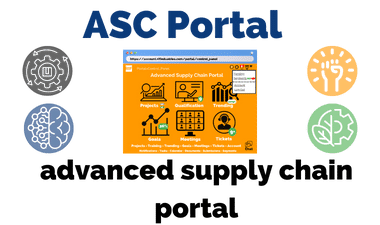
Portal

- SCO: supply chain operators
- LOG: logistics
- Qualified industry vertical (IV) and supply chain operators (SCO)
Click a project to view its details, including segments.
Segments, customization, management

- Notifications for missing pieces
- Customizations
- Qualification notifications
- Payment methods
“Submit” sends the project to the SCOs for review.
Qualification overview & search

- Industry vertical search
- Links to each IV qualification status
- Links to each SCO qualification status
- Auto settings, including qualification links for created segments
- Quick qualification completion wizard
“New” starts an industry vertical search.
Qualification registration & completion wizard

- Video for both IV and SCO
- Q&A or quiz, with profile completion for the IV and basic knowledge for the SCO
- SOP for SCO qualification, acknowledging the step-by-step processes
- Terms and conditions: the product or service provider’s requirements
Finish with the quick qualification completion wizard.
References
- ↑ Milinx Business Group: The hosted desktop. Maynard L. Dokken, the record. maynardldokken.com/milinx/#desktop
Every source above was opened and checked on 3 November 2026.
Further reading
- RIF Industries. Maynard L. Dokken, the record. maynardldokken.com
- API. Wikipedia. en.wikipedia.org
- Software development kit. Wikipedia. en.wikipedia.org
- Standard operating procedure. Wikipedia. en.wikipedia.org
- Logistics. Wikipedia. en.wikipedia.org
- Open-source software. Wikipedia. en.wikipedia.org
- Supply chain management. Wikipedia. en.wikipedia.org
Background on the subjects of this page, not cited above. Each link was opened and checked on 3 November 2026.